Saturday, March 24, 2018

Intimacy in Marriage - Week 11

In addressing sexual intimacy, as a member of the Church of Jesus Christ of Latter-day Saints, I feel like this topic is something that most of the time is an uncomfortable topic to discuss.  This is a sacred topic that is usually addressed to the youth in terms of “do’s and don’ts”.   Many warnings and examples are given to youth so they can avoid a bad situation.  However, not much is really said about intimacy after wedding vows have been made.   This is not a good idea.  All youth, young men and young women need to be educated in the sanctity and importance of sexual relations after marriage. 


Image result for couple picture


In marriages, sexual intimacy is not only to multiply and replenish the earth, it is to bring oneness and joy to the marriage.  Couples know how to talk about finances, housework, children, work, but often times they do not know how to talk about sexual relations.  Many times, this leads to frustration and even leads couples to believe they are not compatible. “Yet, in spite of the potentially joyful aspects of sexuality in marriage, for many it is a source of frustration and even contention. Indeed, the inability of married couples to intimately relate to each other is one of the major causes of divorce. President Spencer W. Kimball noted that even in our own church, “if you study the divorces, as we have had to do in these past years, you will find there are one, two, three, four reasons. Generally, sex is the first. They did not get along sexually. They may not say that in court. They may not even tell that to their attorneys, but that is the reason” (The Teachings of Spencer W. Kimball, ed. Edward L. Kimball, Salt Lake City: Bookcraft, 1982, p. 312.) (Brotherson, 2003).

Having an open dialog with your spouse in this area may be difficult if there is already tension and may impact communication and can lead to insecurity, anxiety, anger, emotional alienation, even divorce.  Many couples suffer silently.  If you are feeling disconnected sexually in your marriage, it may be that questions may need to be asked.  Gaining knowledge and understanding how your own body functions biologically, as well as understanding your partners responses are essential in helping find a healthy sexual relationship. 

Communicating about sexual intimacy can become more comfortable over time, but couples must practice, and express feelings in specific ways.  They will learn to trust each other. “So often when a husband and wife talk to each other about their sexual needs, their conversations are … indirect, imprecise, inconclusive. Frequently both partners are in a hurry to end the conversation, hopeful that they will miraculously understand each other's desires without much talk … The problem is that the less clear you are about what you do and don't want, the less likely you are to get it. Sex can be such a fun way to share with each other and deepen your sense of intimacy. But when communication is fraught with tension, then frustration and hurt feelings too often result” (Gottman, 2015).



Image result for couple picture


“In summary, sex should be a celebration. It comes from God. He created our sexual appetites and natures. He has ordained us to make love both physically and spiritually. He is pleased when He sees us bonded together sexually, in love, for this is the plan of creation. And this plan permits the husband and wife to jointly participate in creating new life and, in a sense, perpetuate part of themselves into eternity through their children. The sexual embrace should never be a chore or a duty, but a loving part of a larger relationship. Of giving to our partner, cherishing, respecting, protecting each other. It won't always be easy. But the rewards can be incredibly great if we choose to make them so.” (Brotherson, 2003).


Brotherson, S. E. (2003) They Twain Shall Be One: Thoughts on Intimacy in Marriage.  Meridian Magazine.  Retrieved from https://ldsmag.com/article-1-10072/


Gottman, John M. PH.D., Silver, Nan. (1999, 2015 second edition) The Seven Principles for Making Marriage Work. Harmony Books New York

Friday, March 16, 2018

The Marital Poop 💩 Detector and Criticism - Week 11

Marriage is an amazing journey!  We choose to navigate life’s greatest joys and challenges with our best friend and lover.  During this process, we will all undoubtedly have marital issues at one point or another.  Couples that have high expectations of their relationships and want to work out their issues, have the highest quality marriages.  And with all of the current emoji “pop-culture”, it’s fitting that we can see how our marriages are measuring up using the “The Marital Poop ðŸ’© Detector.”   This is actually a tool that Dr. Gottman created for couples to stay better connected.  This is a list of twenty-five assessments statements that you and your partner can review daily, weekly or whenever you need a “check-in” to evaluate how connected you and your partner are feeling. Dr. Gottman offers twenty-five, but here are a few; 


1 – “I have been acting irritably.

2 – I have been feeling emotionally distant.

3 – There has been a lot of tension between us.

4 – I find myself wanting to be somewhere else.

5 – I have been feeling lonely.

6 – My partner has seemed emotionally unavailable to me.

7 – I have been angry.

8 -  We have been out of touch with each other.

9 – My partner has little idea of what I am thinking.

10 – We have been under a great deal of stress, and it has taken its toll of us” (Gottman, 2015).

This is just a sampling, but the idea is to go over these questions together and honestly, and gently, talk about each question.  Using active listing skills, soft start-ups, and a lot of empathy and love, together you can start to reconnect.  It’s easy to lose touch with your spouse and this is a great way to stay coupled. 


Gottman also talks about criticism.  He says, “There is no such thing as constructive criticism.  All criticism is painful—criticism doesn’t make a marriage better.”   He talks about two sources that causes a spouse to be chronically critical. First, the spouse is emotionally unresponsive.  It is very easy to become critical of an unresponsive mate.  They don’t unload the dishwasher when you ask, so after a while, you become less patient with your requests and your approach is more than likely more critical, causing your spouse to become more unresponsive.  “It takes courage to be less critical of an unresponsive mate, and it takes courage to turn toward a partner who’s always harping on your flaws.  But both changes are necessary to end the cycle” (Gottman, 2015).  You make the choice to end the cycle.


The second source of criticism in marriage comes from within.  This is criticism that we have all developed over a lifetime.  It is one of self-doubt and inadequacy.  Even after our great accomplishments as adults, this criticism sneaks in and has us telling ourselves, many times, that we are not good enough.  We are our own worst critic.  Gottman suggests that if you are always looking for your own flaws and consider yourself inadequate, you will always be looking for what is NOT there in yourself and your partner.  He says that the best thing you can do for yourself and your marriage is to accept yourself, flaws and all.  This will help you accept who you are and look for the good in yourself of and your spouse.  We take for granted the many wonderful qualities that our partners possess when we are preoccupied with what’s not there.  Many people achieve personal acceptance by religious means of using the path of religious forgiveness.  Some use prayers of thanksgiving and focus on the things in which they are grateful.  Then maybe one day, you will have healing of your soul and feel more accepting of yourself and what a wonderful feeling that will be.


Goddard H. W. (2009). Drawing heaven into your marriage: eternal doctrines that change relationships. Cedar Hills, UT: Joymap Publishing.

Gottman, John M. PH.D., Silver, Nan. (1999, 2015 second edition) The Seven Principles for Making Marriage Work. Harmony Books New York

Saturday, March 10, 2018

Perpetual and Solvable Conflict

After two people get married, routines begin, the dust settles, and the happy couple might find, to their surprise, that they get irritated with each other at times.  We have to be realistic here.  When we married our partners, we all chose the person that we were going to live with the rest of our lives, which includes all the quirks that come with them.  Disagreements, minor irritations, annoyances, conflict; it happens to the best of couples!  Being able to identify what type of conflict you are having with your spouse can help you with what type of strategy to use in helping to resolve it.  There are two categories of conflict; perpetual and solvable.

Perpetual conflict consists of typical ongoing conflict that does not go away over long periods of time.  An example of this might be one parent wants to raise their child Jewish and the other wants to raise the same child Catholic.  Or one partner is ready to have a baby and the other isn’t.  Or one spouse is more lax with housework than the other, which makes the other angry and nag.  This type of conflict is long lasting, and will probably still be an issue, years in the future.  Many couples use humor as a strategy and approach to smooth over their issues.   “Despite what many therapists will tell you, you don’t have to resolve your major marital conflicts” (Gottman, 2015).  Many couples cope with their problems by keep talking about them, acknowledging them, and joking about them, knowing that they may not change, but if they are talking about their issues, they will not overwhelm their marriage either.


Gridlock is a state that can happen if perpetual conflict is not coped with well, in an unstable marriage.  Gottman says that some signs of gridlock include feeling rejected by your partner, being unwilling to budge on your side of the conflict, no humor or affection toward spouse, and you disengage from your spouse emotionally.  These are very dangerous signs that are extremely painful. 
**There is a way out of gridlock, but you both have to be willing.  The key to this, and the start of getting out of gridlock, according to Gottman, starts with sharing with each other the significant personal dams you have for your life.  Meaning, the endless argument symbolizes some profound difference between the two of you that needs to be addressed before you can put the problem in its place” (Gottman, 2015).

Solvable Problems sound simple enough, but if not treated properly and with respect, can be quite painful.  They do not always get resolved and can cause much tension in a marriage.  It is one thing to think, hey I can try to think how my spouse feels when we are having conflict, then I will know how to solve this problem.  It doesn’t work like that, we really don’t know how other’s feel, we only know how we feel and how we respond to a situation. Gottman gave five steps in how we can help with solvable problems.


1.   Soften your start-ups – This deals with HOW you initiate introducing a conflict conversation. 
2.   Learn to make are receive repair attempts – This is when One partner makes a statement or action silly or not to prevent a bad situation to spiral out of control. 
3.   Soothe yourself and each other – this is just taking a break so both you and your partner do not get to the point of feeling flooded.
4.   Compromise – you don’t always get your way.  This is the only way to solve marital problems.
5.   Process and grievances so that they don’t linger.  You must discuss what triggers caused these problems in the first pace and how to avoid them in the future.  


Marriage is supposed to be an awesome experience where we are not supposed to have huge problems and conflict.  In addition to these great strategies listed, another strategy to help us avoid conflict is looking to the Lord.


We can certainly have a different perspective: an eternal perspective.  In the Church of Jesus Christ of Latter-day Saints, when we enter our temples and marry, we not only are married here on earth, but we are sealed to our spouse for eternity.  “While some may argue that they do not care to be sealed eternally to the spiritual pygmies who are their partners, those who understand the things of God know that their imperfect partners will one day be made glorious.  One day we may feel honored to have known the people we now disdain” (Goddard, 2009). 


I know that there are times that I get frustrated with my husband, but I also know that if I just take a step back and look at the bigger picture, where I am here to help my husband, and he is here to help me through this life.  My patience and love for him is what fills my heart.  “Consecration is a covenant that moves us from asking how we can get our needs met to how we can bless and serve.  We become more grateful.  Rather than wondering if this marriage is a good investment that will pay us a handsome return, we ask for heavenly grace that we may love and serve as Jesus served—without thought of reward.  While there are destructive relationships that should end, the vast majority of relationship can survive and flourish if each of us brings our whole soul as an offering” (Goddard, 2009).


Goddard H. W. (2009). Drawing heaven into your marriage: eternal doctrines that change relationships. Cedar Hills, UT: Joymap Publishing.


Gottman, John M. PH.D., Silver, Nan. (1999, 2015 second edition) The Seven Principles for Making Marriage Work. Harmony Books New York


Friday, March 2, 2018

Beware of Pride - Week 8

Pride is an interesting concept because when you are wrapped up in it, you don’t feel like you are doing anything wrong.  This is why pride is so dangerous.  I decided to listen a sermon called Beware of  Pride, by President Ezra Taft Benson.  To my pleasant surprise, it was delivered by Gordon B. Hinkley. The words of this talk are straight forward and powerful.  For a long time after this talk, I remember it was almost taboo to use the word “proud.”   President Benson teaches that, “The central feature of pride is enmity—enmity toward God and enmity toward our fellowmen. Enmity means “hatred toward, hostility to, or a state of opposition.”  It is the power by which Satan wishes to reign over us.  Pride is competitive in nature.  As Paul said, they “see their own, not the things which are Jesus Christ’s” (Philip 2:21) (Benson, 1989).  Proud people do not like people telling them what to do, and do not think what they are doing is wrong.  However, pride is always a sin.

In any relationship, especially marriage, since we are together so often, there are many times we become annoyed with our spouse.  This is not their problem, this is our problem.  When ever we feel like we need to complain to our spouse and “fix” them, we are suffering with pride.  “The natural man is inclined to love himself and fix others.  God has asked us to do the opposite.  We are to fix ourselves by repenting, and to love others” (Goddard, 2009).  When we find ourselves irritated by small, or for that matter, large things, that our spouses say or do, we need to be the ones to re-evaluate our inner intentions toward them.  Repenting includes asking for God’s mercy. “...that he would have mercy upon you.  Yea, cry unto him for mercy, for her is mighty to save” (Alma 34:17-18).  “The more you can agree about the fundamentals in life, the richer, more profound, and, in a sense, easier your marriage is likely to be” (Gottman, 2015).   


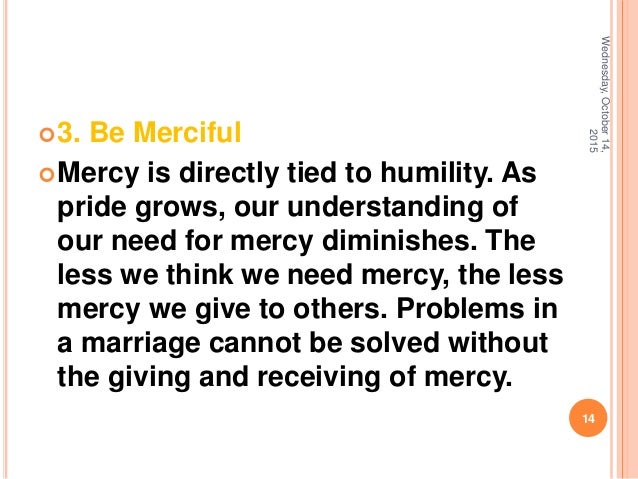
“The antidote for pride is humility—meekness, submissiveness. It is the broken heart and contrite spirit” (Benson, 1989).  "But humility is not something reserved to be taught only to children. We must all strive to become more humble. Humility is essential to gain the blessings of the gospel. Humility enables us to have broken hearts when we sin or make mistakes and makes it possible for us to repent. Humility enables us to be better parents, sons and daughters, husbands and wives, neighbors and friends.  On the other hand, unnecessary pride can dissolve family relationships, break up marriages, and destroy friendships. It is especially important to remember humility when you feel contention rising in your home. Think of all the heartache you can avoid by humbling yourself to say, “I’m sorry”; “That was inconsiderate of me”; “What would you like to do?”; “I just wasn’t thinking”; or “I’m very proud of you.” If these little phrases were humbly used, there would be less contention and more peace in our homes" (Snow, 2016).  There are many ways in which we can choose to be humble.  One way we can accomplish this is by taking time to serve others, whether it is a family member, neighbor, church member, or service in the temple.  Submitting to the will of God, instead of our own will, shows that we are humbling ourselves and loving others more than ourselves.  Showing mercy to others, also helps us master our quest for being humble.  We are not perfect beings.  We should show mercy to others the way that Christ had mercy on the lives of those he touched in the examples of the scriptures.


In marriage, it is hard to bite your tongue and let things that bother you slide sometimes.  We need to remember that when we marry our cherished spouse that we want to build a wonderful life with them.  We can accomplish this by creating shared meaning and goals. Essentially families are a mini-culture that is created by two people building their family foundation on shared goals and values.  This can only be done with respect, love, appreciation of each other’s differences, and realizing that a “rewarding marriage is about more than sidestepping conflict.  A crucial goal of any marriage, is to create an atmosphere that encourages each person to talk honestly about his or her convictions.  The more you talk candidly and respectfully, the more likely there is to be a blending of your sense of meaning” (Gottman, 2015).
 If you have time, this is an excellent talk on Pride from President Uchtdorf. 

Benson, E. T. (1989) Beware of Pride. Ensign. Retrieved from https://www.lds.org/general-conference/1989/04/beware-of-pride?lang=eng

Goddard H. W. (2009). Drawing heaven into your marriage: eternal doctrines that change relationships. Cedar Hills, UT: Joymap Publishing.


Gottman, John M. PH.D., Silver, Nan. (1999, 2015 second edition) The Seven Principles for Making Marriage Work. Harmony Books New York


Snow, S. E, (2016) Be Thou Humble. Ensign. Retrieved from https://www.lds.org/general-conference/2016/04/be-thou-humble?lang=eng

Friday, February 23, 2018

Turn Toward Each Other Instead of Away – Week 7


Respond to stressful times by turning toward each other, rather than away from each other.                             
                                                                        -Tim DeChristopher


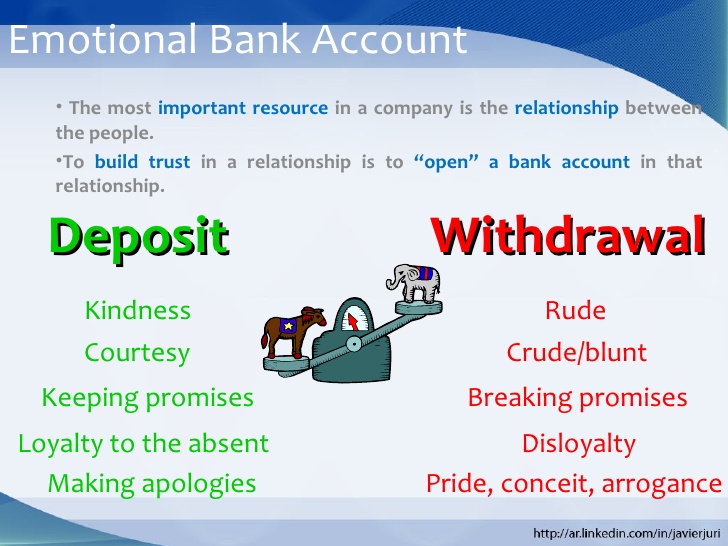
Turn toward each other instead of away - is the third principle that Dr. John Gottman suggests we use in our marriages, as a way to help them work.  What does this mean?   Well, if you are married, you are practicing this principle either positively or negatively, daily, whether or not you know it.  Let me explain.  First of all, Gottman talks about making “bids” for our partner’s attention.  One makes a “bid” by trying to get some type of reaction like, affection, humor, attention or support, from someone else.  “Bids can be as minor as a back rub, or as significant as seeking help in carrying the burden when an aging parent is ill.”  The key is how your partner, or you, respond to a bid; you either turn toward your spouse, or away from them.  “A tendency of turning toward your spouse is the basis of trust, emotional connection, passion, and a satisfying sex life” (Gottman, 2015).   This creates a positive atmosphere and “banks” a positive balance in your relationship “emotional bank account.”  This is such a great way to illustrate the trust that can be built, “a deposit”, by turning toward your partner; or the lack of trust, “a withdrawal,” when a “bid” is rejected or thrown aside.  We also must make time for each other so we have opportunities to grow together.

This is all about how you react to the small things in your marriage. For instance, the wife asks the husband to please take out the garbage; the husband has two choices. He can willingly and lovingly just take out the garbage (even though he really doesn’t want to, but knows it means a lot to his wife), OR he can begrudgingly take the garbage out, complaining the whole time (which drags everyone down). Which scenario is increasing the balance in the wife’s “emotional bank account?” You got it! The first choice will bring a positive feeling into the couple’s relationship. I believe the most amazing thing about this principle is, most people are not thinking, “I need to make some deposits in my partner’s emotional bank account.” They just make a “whatever” decision based on their mood at the time. Sometimes it works for good, sometimes it doesn’t.


Intentional living is a concept that I have become more interested in over the years.  This is living your life with a conscious attempt to live by your values and beliefs which brings clarity and focus into your life.  Intentional living goes hand in hand with turning toward your spouse because it means you are making an effort to help improve your marriage or relationship.  You are choosing to make your marriage happy by making an effort to build, and lift up your spouse.  Turning toward your spouse, when you hear a “bid” from them, can dramatically change the dynamic of your marriage relationship.  If, one day, you hear your spouse say something under their breath, ask them if you can help them in any way.  Find out what their need is at that moment and decide to do something to help them out.  You will see your marriage change for the better, because this type of work is based on selflessness.  This after all, is what everyone wants in a marriage; someone to love unconditionally and someone to do the same in return.


President Gordon B. Hinkley counseled, “I find selfishness to be the root cause of most of the problems that lead to broken homes. I am satisfied that a happy marriage is not so much a matter of romance as it is an anxious concern for the comfort and well-being of one’s companion.  The remedy for most marriage stress, it is in repentance.  …. It is found in the Golden Rule” (Goddard, 2009).  
Establishing a good foundation to a marriage is based on treating your spouse the way you want to be treated.  

John 14:34 reads, "A new commandment I give to you, that ye love one another as I have loved you, that ye also love one another" (John 13:34, Authorized King James Version).  This scripture teaches us that if we love God, we will love one another . How does Jesus love?  Unconditionally.  In Ephesians 4:32 it says, "Be kind to one another, tenderhearted, forgiving one another, as God in Christ forgave you."  Loving, turning the other cheek, repenting and forgiving others, are eternal principles intertwined with the Atonement of Jesus Christ.  We need to remember to bring God and Christ into our marriages.  Our spouses are not perfect.  We will, at one time or another, say an unkind word, forget to be somewhere after we have committed our time, or even forget to take out the garbage. “Couples often ignore each other’s emotional needs out of mindlessness, not malice" (Gottman). The point is, we are here to work on perfecting ourselves as well as improve our relationship with God.  

We must recognize that even though we love and cherish our spouses, they are not perfect.  “Faith in the Lord Jesus Christ requires that we trust God is working to rescue our spouse even as he is working to rescue us.  When we have energizing faith in Christ, we trust His progress with our partner. The more we trust God’s purposes in perfecting our partners, (and don’t try to take over the job ourselves), the more we all progress” (Goddard, 2009). It’s easy to be judgmental of your spouse, but we must remember, we are all works in progress.

Remember, we are all human.  We need to remember to forgive, instead of taking offense.  In these moments, ponder principle #3 in The Seven Principles for Making Marriage Work– turn toward each other instead of away.  Make an intentional decision on how you are going to live your life and how you can positively build your marriage.  Hopefully, we will choose to act in such a way that helps bring love, peace, and harmony into our marriages. 

I just wanted to publicly thank my classmates for helping review and edit my blogs posts.  Thanks Margaret, Cassie, and Staci!  Good luck to you all with the remainder of the semester!


Goddard H. W. (2009). Drawing heaven into your marriage: eternal doctrines that change relationships. Cedar Hills, UT: Joymap Publishing.


Gottman, John M. PH.D., Silver, Nan. (1999, 2015 second edition) The Seven Principles for Making Marriage Work. Harmony Books New York

Saturday, February 17, 2018

Love Map & Nurture your Fondness and Admiration - Week 6

Marriage is like a muscle; if you don’t work on it, it will wither.  Couples need to continually work on their marriage to make it strong.  This enables their marriage to resist the temptations that might cause it to be destroyed. 

It’s very normal for a marriage to be tested; in fact it is unavoidable.  Some couples think that they should have a great marriage without putting in the work to attain one.  Part of having a happy marriage requires sacrifice.  “When we make sacrifices, we are following the Savior, who sacrificed everything in order to rescue us. The willingness to put our preferences on the altar in obedience to God and service our partner is a sacrifice filled with grace and truth” (Goddard, 2009).  When we have issues in our marriages, if we willingly make sacrifices in behalf of our spouse, we become more like our Savior, displaying unconditional love.

In our quest for strengthening marriage, Dr John M. Gottman shares seven principles which will help, in his book, The Seven Principles for Marking Marriage Work.  The first and second principles are Enhance your Love Map and Nurture Your Fondness and Admiration.  

Principle #1 – Enhance your Love Map

What is a “Love Map?” 

Gottman states that love maps are the cognitive understanding of your partner’s inner-psychological world.  Couples that spend time strengthening and updating their Love Map, remember the major events in each other’s history and keep updating this information as the facts and feelings of their partner’s world change.  “Couples who have detailed love maps of each other’s world are far better prepared to cope with stressful events and conflict” (Gottman, 2015). 

For marriages to be strong, and remain strong, it is imperative that we take an ongoing interest in our spouse.  We should always be in tune with their needs, wants, goals, desires, life-long ambitions, fears, insecurities, hurts, injuries, hopes, and dreams.   There are  exercises that Gottman suggests, to help a couples’ love map grow within their relationship.  Here is a short sample of the questionnaire that Gottman put together to help couples strengthen their love maps of each other.  He encourages couples to make time to go through these exercises to help increase their knowledge about one another.


Enhancing your love map is just the first principle in making your marriage work.   This is a continuous effort in learning about your spouse, to help you grow together.  “Happily married couples don’t just know each other, they not only use their love maps to understand each other, but to express fondness and admiration as well” (Gottman, 2015).

Principle #2 – Nurture your Fondness and Admiration

When you are thinking positively about another person, your emotional state is positive.  When you think negatively about someone, your emotional state is generally negative.  This has huge implications when it comes to marriage.   When couples think of their marriage in a positive light, more than likely, their marriage consists of friendship, love, and generally, will be happy and successful.  However, to help their marriage remain in a positive state the couple will need to nurture their fondness and admiration toward each other.  Why?  If a marriage is not nurtured, it will eventually lose its vitality, wither and die. 

Nurturing your fondness and admiration toward your spouse helps you to maintain a sense of respect for them.  Because of this respect, elements like criticism, contempt, defensiveness, and stonewalling (the four horsemen) will be kept at bay.  Nurturing your fondness and admiration is the antidote to contempt, according to Gottman.


How do we accomplish this task without feeling insincere in our attempts to build up our spouse?  One of the exercises that Gottman suggests is called, “I appreciate………”  You and your spouse each choose five phrases on the list and say them to your spouse.  Following each phrase, an example is given.  For instance, “The way you treat my family means a lot to me, (like when you helped my dad till his garden), or “Thanks for bringing me flowers,
(I was having a hard day, and the flowers showed you cared, and I felt loved).  These are samples of how this process works. 

At first, this might seem awkward, however it opens the doors of continued optimism in your marriage, and shows charity your spouse.  Doing this helps squelch negativism in marriages.  Like Cheryl Crow’s sang in her song, Soak up the Sun, the lyrics read, “It’s not having what you want, it’s wanting what you’ve got.”  This is just as simple as taking time to appreciate and love what we already have.


Check out the following radio clip.  It includes Dr's John and Julie Gottman on Nurture Fondness and Admiration. 


Crow, C & Trott, J (2002). Soak up the Sun. [Recorded by Cheryl Crow]. On C’mon C’mon [CD]. New York City: A&M.

Goddard H. W. (2009). Drawing heaven into your marriage: eternal doctrines that change relationships. Cedar Hills, UT: Joymap Publishing.

Gottman, John M. PH.D., Silver, Nan. (1999, 2015 second edition) The Seven Principles for Making Marriage Work. Harmony Books New York

Saturday, February 10, 2018

Behaviors that Negatively Affect Marriage - Week 5

John Gottman is a renowned relationship expert.  He and his wife, Julie, live in Seattle and have studied relationships extensively for over forty years.  He has helped develop a “Love Lab” at the University of Washington that is an apartment where a couple lives for a weekend.  In the apartment, there are cameras installed and heart monitors placed on the participants.  Gottman’s claim is that he can predict, around 91% of the time if a couple will divorce by observing them in a fifteen-minute conversation.  This is amazing to me; however, I understand that Gottman has been studying marriages and relationships for a very long time.  Not only can he predict whether or not a marriage will end, he has also found what will make a marriage last.


Marriage is a great leap of faith, that you and your partner will be able to rely on each other for the long haul.  The great thing is, marriage can be simple.  “Grace and mercy are at the heart of a loving family” (Goddard, 2009).  When we decide to marry, we must realize that we are marrying an imperfect human, and we will have the opportunity to practice patience, long-suffering, charity, and many times, forgiveness.

The belief that a couple can save their relationship by communicating more sensitively is a myth about marriage that can potentially tear it apart.  This is only one myth of many that Gottman talks about in his book, “The Seven Principles for Making Marriage Work”.   Myths are dangerous in that they can “lead couples down the wrong path or, worse, convince them that their marriage is a hopeless case” (Gottman, 2015).  The following myths are the most common.   

Related imageNeuroses or personality problems ruin marriages. 

“We all have issues we are not rational about.  These triggers are called ‘enduring vulnerabilities’ (Gottman,2015), and when used against our partner, they can cause marriages to unravel.  Everyone has a quirk or something odd about them.  It is finding the right partner, someone with whom you can get along with, that makes happy relationships.  If you can figure out how to respect and accommodate your partners neuroses, you can have a successful relationship.

Common interests keep you together. 

This depends on how you interact with your spouse during the activity.  If the activity builds comradery, and enhances love and friendship, then great.  If the activity is not benefiting the marriage, because of disagreements on how to do the activity or one spouse is criticizing the other in the way they are participating, then it’s not worth joining in that activity together.  

You scratch my back and ……..

Some believe that if you do something nice for your partner,  your partner needs reciprocate quickly.   With good, strong relationships, there is no keeping score.  One loves and serves the other because they genuinely love and want to serve them.  As soon as one starts tallying up who has done more for the other, problems will arise in your marriage.
Image result for couples fighting pictures silhouettes
Avoiding conflict will ruin your marriage.

Every couple handles conflict differently.  Some couples choose to not address conflict and avoids fighting at all costs. Some couples argue a lot, and some are able to talk out their differences with compromise.  It doesn’t matter what style is used as long as it works for both people.

Affairs are the root cause of divorce

When a marriage is in trouble, couples are not having their needs of a fulfilling relationship met.  This can send couples looking for an intimate connection outside the marriage.  This is less about sex than it is about filling a need of support, friendship and understanding, respect, attention caring and concern.  “80% of divorced men and women said they broke up because they gradually grew apart and didn’t feel loved or appreciated” (Gottman, 2015).

Men are not biologically built for marriage.

It is assumed that men are philanderers by nature and ill suited for monogamy.  However, extramarital affairs do not depend on gender as much as opportunity.  Since women have entered the workplace in droves, the number of extramarital affairs of young women now slightly exceed those of men” (Gottman, 2015).
Image result for men are from mars women are from venus pics 
Men and women are from different planets.

Many people have heard that men are from Mars and women are from Venus.  The following statistic is why this is not true.  Dr. Gottman states that “the determining factor in whether wives feel satisfied with the sex, romance, and passion in their marriage is, by 70%, the quality of the couple’s friendship… and for men, the determining factor is, by 70%, the quality of the couple’s friendship… so men and women come from the same planet after all.” Gender may contribute to marital problems, but they don’t cause them. 

Gottman suggests that the key to a happy marriage is a deep friendship.  This means that you are genuinely concerned about your partner.  That you feel what they are feeling.  You enjoy each other’s company and want to make sure that person is happy.  You support them in their hopes and dreams, love them for their quirks and show your love for them not only in big ways, but also in the small, simple gestures made every day.  Fostering this friendship is they key to a happy marriage.  Gottman uses the term, “attunement” to show how couples are “in tune” to their spouse.  This means that you literally feel what your partner feels.  Trust and commitment are essential to a happy marriage.  In turn, their happiness is contingent on their partners feelings.

I am one lucky lady because I found and married my best friend.  We laugh together, cry together, and rely on each other for support and special connections.  We have been married for 26 years, and counting.  I believe that we have accomplished this because we have fostered our friendship.  We do not go outside our marriage for this type of relationship.  We have each other’s back and are on the same team, rooting for each other and our family.  “When we focus on our discontent, we will blame others. In contrast, when we focus on someone else’s pains, we are more likely to have compassion” (Goddard, 2009).


To read more on exposing the myths of marriage click on the links below.

http://www.readersdigest.ca/health/relationships/7-common-marriage-myths-busted/view-all/


Goddard H. W. (2009). Drawing heaven into your marriage: eternal doctrines that change relationships. Cedar Hills, UT: Joymap Publishing.

Gottman, John M. PH.D., Silver, Nan. (1999, 2015 second edition) The Seven Principles for Making Marriage Work. Harmony Books New York

Marriage Transitions

               Marrying your best friend is the best thing that anyone can hope for in their lifetime.  Joy and marital bliss is what all co...